If you read nothing else
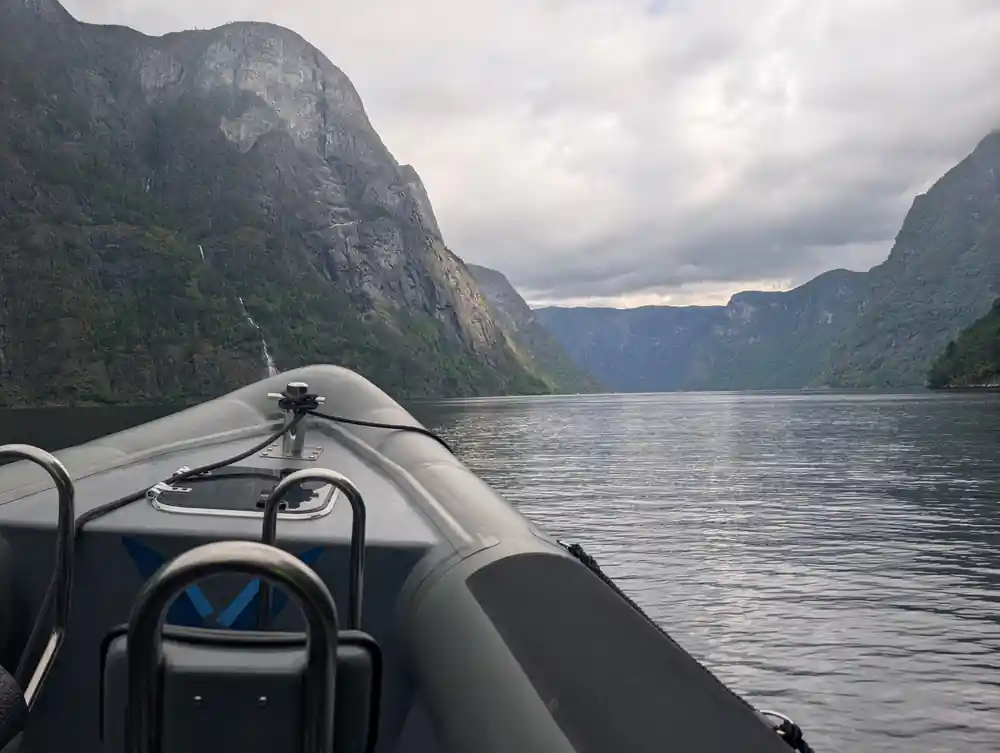
- Rigid inflatable boat: a hard hull with an air tube collar, an outboard on the back and no cabin, so you sit at water level with the sky overhead.
- Narrow water, shallow edges and waterfalls close to the shore. A small open boat can go where a ferry cannot and turn in its own length.
- Planing hull, wind, spray and a loud engine, with rock walls rising on both sides and cold air coming off the water.
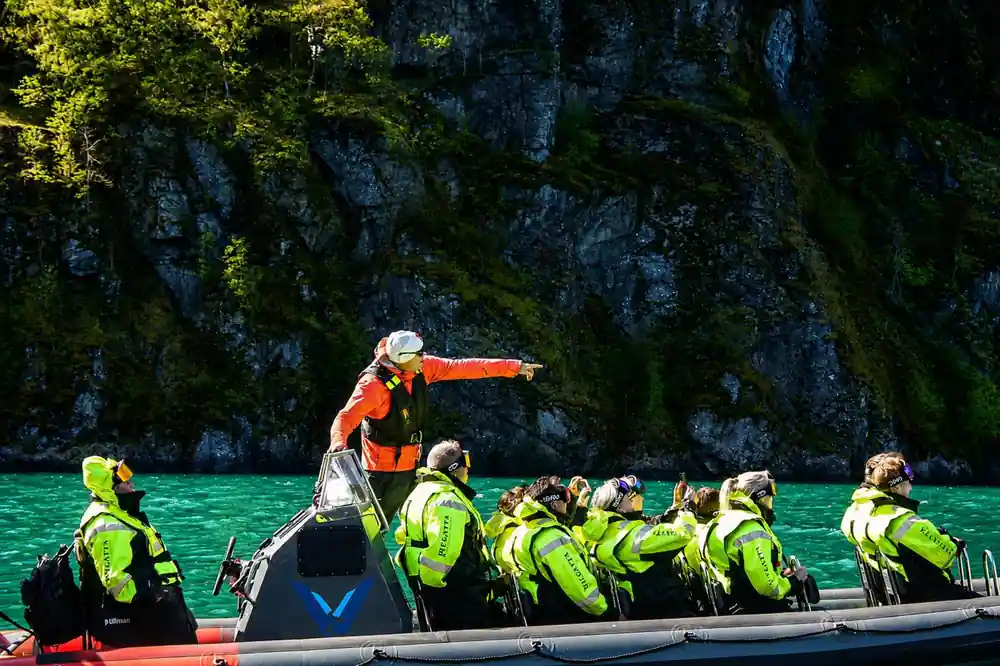
- Layers, a windproof outer shell and something to keep spray off your face. Ask what protective gear is supplied before you book.
- The Flåm RIB experience is listed from US$146 and takes 2 hours, with a live guide in English and free cancellation up to 24 hours in advance.[1]
| RIB boat | Fjord cruise | Flåm Railway | |
|---|---|---|---|
| From | from US$146[1] | from US$62[2] | from US$396[3] |
| Duration | 2 hours[1] | 2 hours[2] | 11 hours[3] |
| Where it goes | Flåm out to the waterfalls | Flåm to Gudvangen, one way | Myrdal, Flåm, Nærøyfjord |
| The ride | Open, fast, low to the water | Indoors, steady, dry | A slow climb on a mountain line |
The Nærøyfjord is unique with steep mountain inclines, ascending 1800 metres high, wild waterfalls, and a living cultural landscape.
Is the Nærøyfjord RIB worth it?
Things to check
- Check the starting time shown for your date, as times differ from day to day
- Compare the from-price of the RIB with a fjord cruise before you decide
- Free cancellation up to 24 hours in advance[1]
- Ask how many people share the boat and whether your group fits comfortably
On the water
- Sunglasses on a strap, because spray and glare arrive together
- Dress warmer than the village feels, the water keeps the air cold
- Keep both hands free when stepping down into the boat
- Allow 2 hours on the water[1]
What a RIB actually is
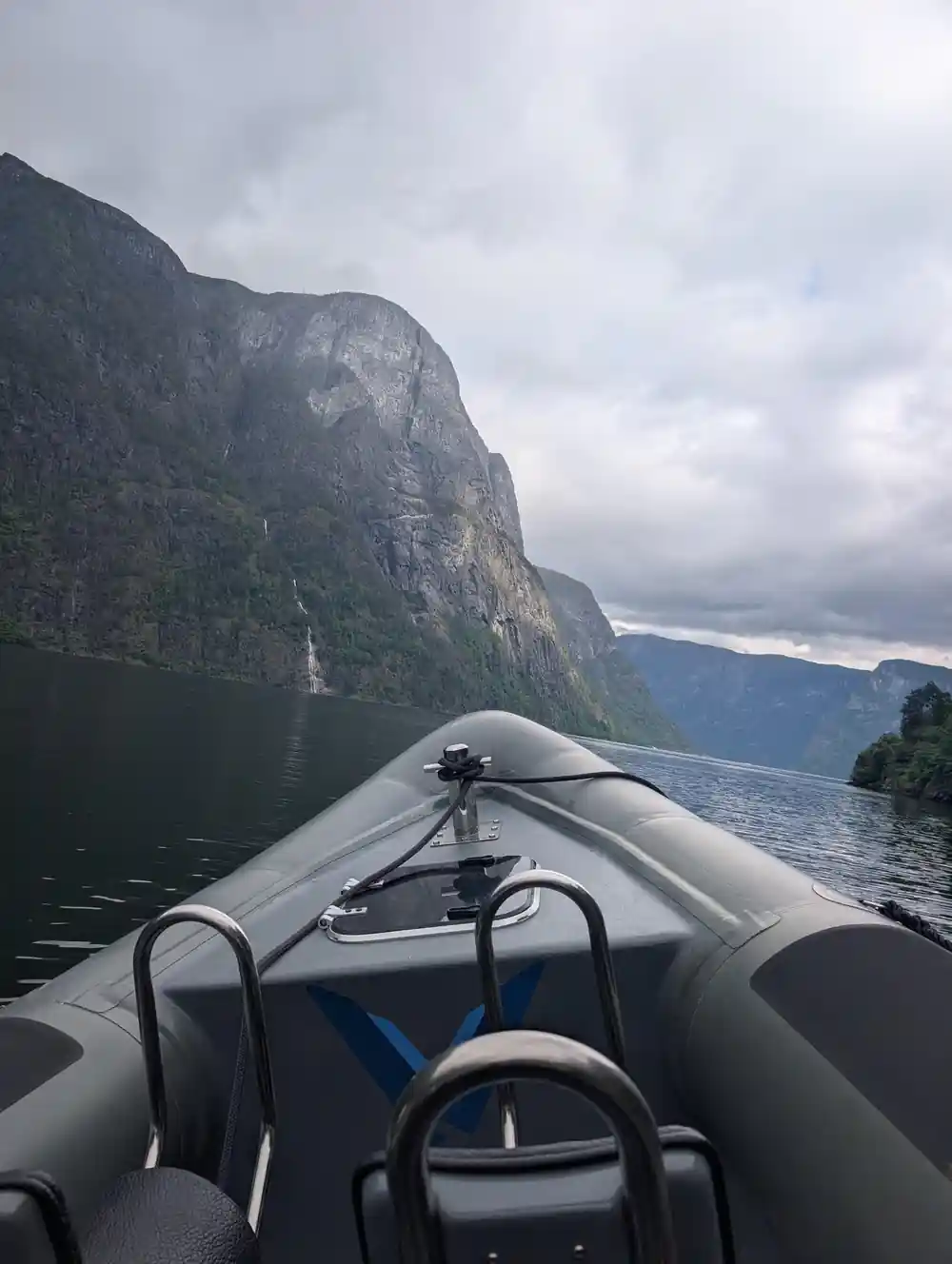
A rigid inflatable boat is exactly what the name suggests: a hard hull with a ring of air-filled tubes around the top edge. The hull gives the boat its shape and its grip on the water, and the tubes give it buoyancy plus a soft, bouncy rim that can nudge a pontoon without doing damage. There is no cabin, no windscreen and no saloon. You sit on a bench with the fjord about a metre below your feet and the sky directly above your head.
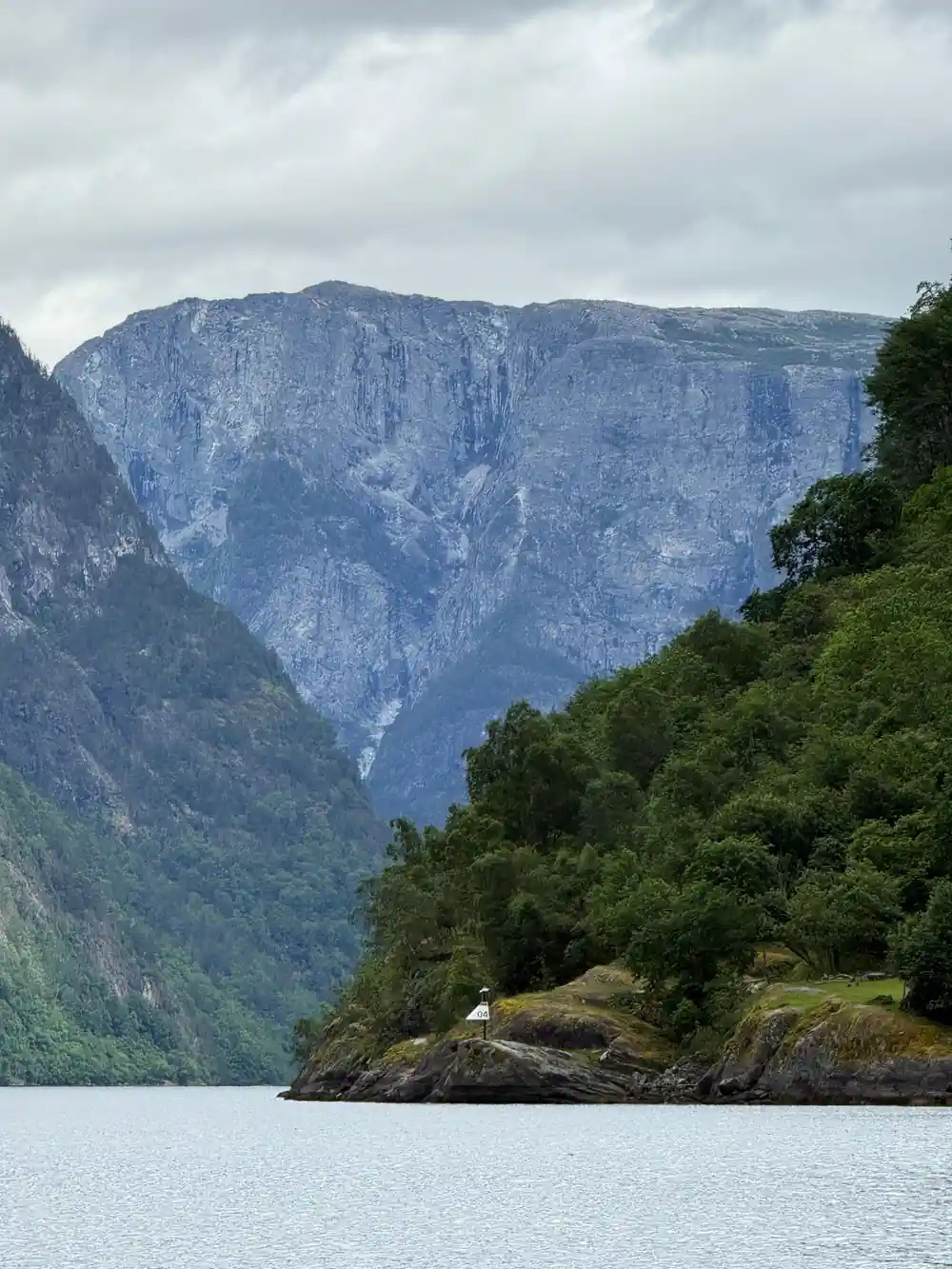
That open layout is the whole point on a narrow fjord. From a low seat you see the water at eye level, the cliffs going up out of sight, and the shoreline detail that a bigger boat sails straight past. The Nærøyfjord is 20 km long and only 250 meters across at its narrowest point[4], and the steep mountain inclines above it ascend to 1800 metres high[5]. A small open boat turns that geography into something you feel rather than look at.
What the letters mean
RIB stands for rigid inflatable boat. The rigid part is the hull, usually fibreglass or aluminium. The inflatable part is the collar of tubes around it, divided into separate compartments so that a puncture is an inconvenience rather than an emergency. That collar is what makes the design so useful here: it absorbs knocks against a pontoon, keeps the boat stable when it is empty, and gives everyone on board something solid to hold when the water gets lively.
The design grew up in rescue and patrol work, where boats have to be fast, stable and hard to sink. Leisure operators borrowed it for exactly those qualities. A RIB can be at speed one minute and nosing into a shallow corner the next, which is not something a ferry or a traditional wooden boat does easily.
The fjord it works in was made by ice. A fjord is formed when a glacier retreats after carving its typical U-shaped valley and the sea fills the resulting valley floor[6]. The result is a channel with steep sides and deep water close to shore, and a boat that can hug the shoreline has an advantage there.
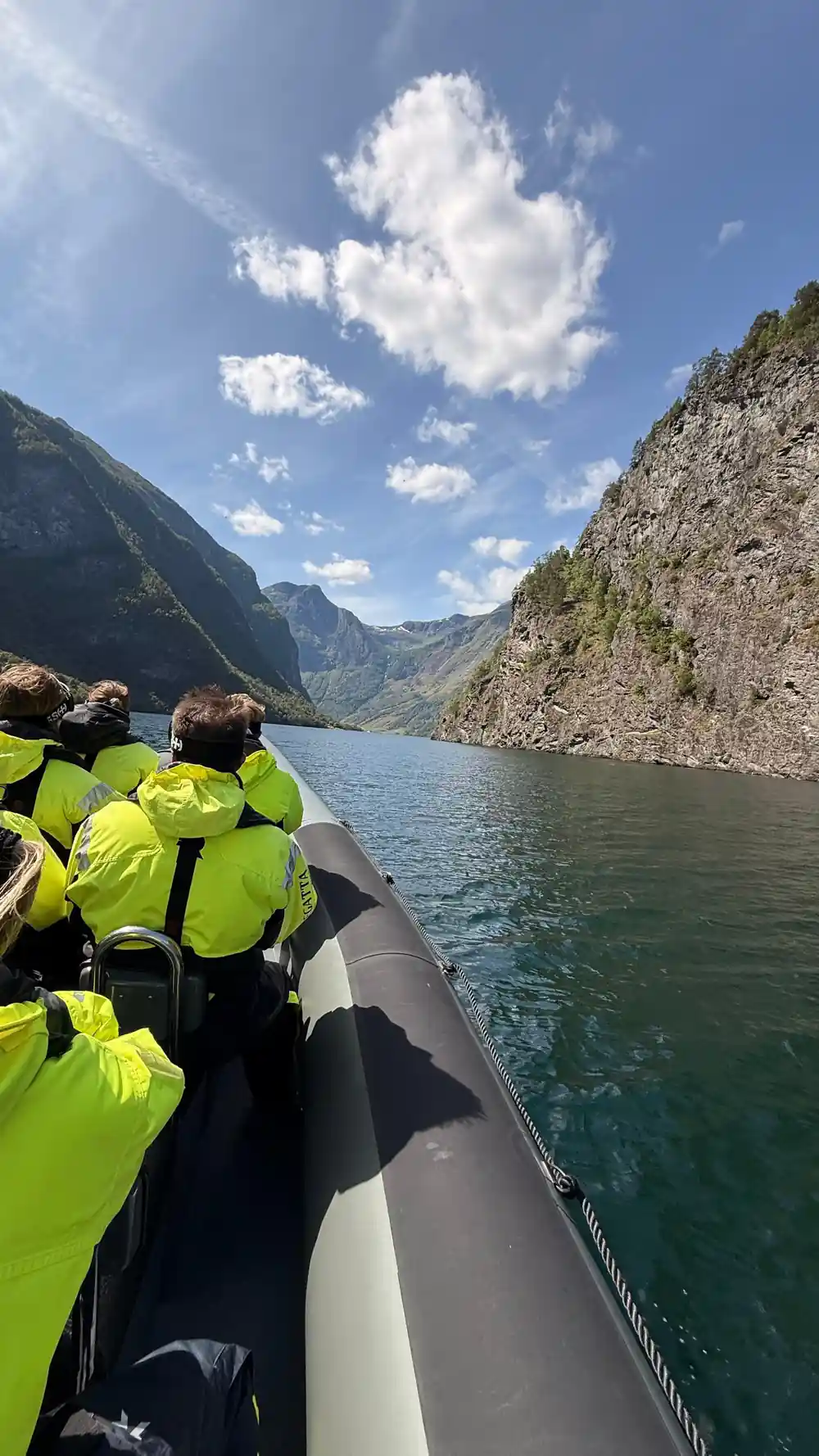
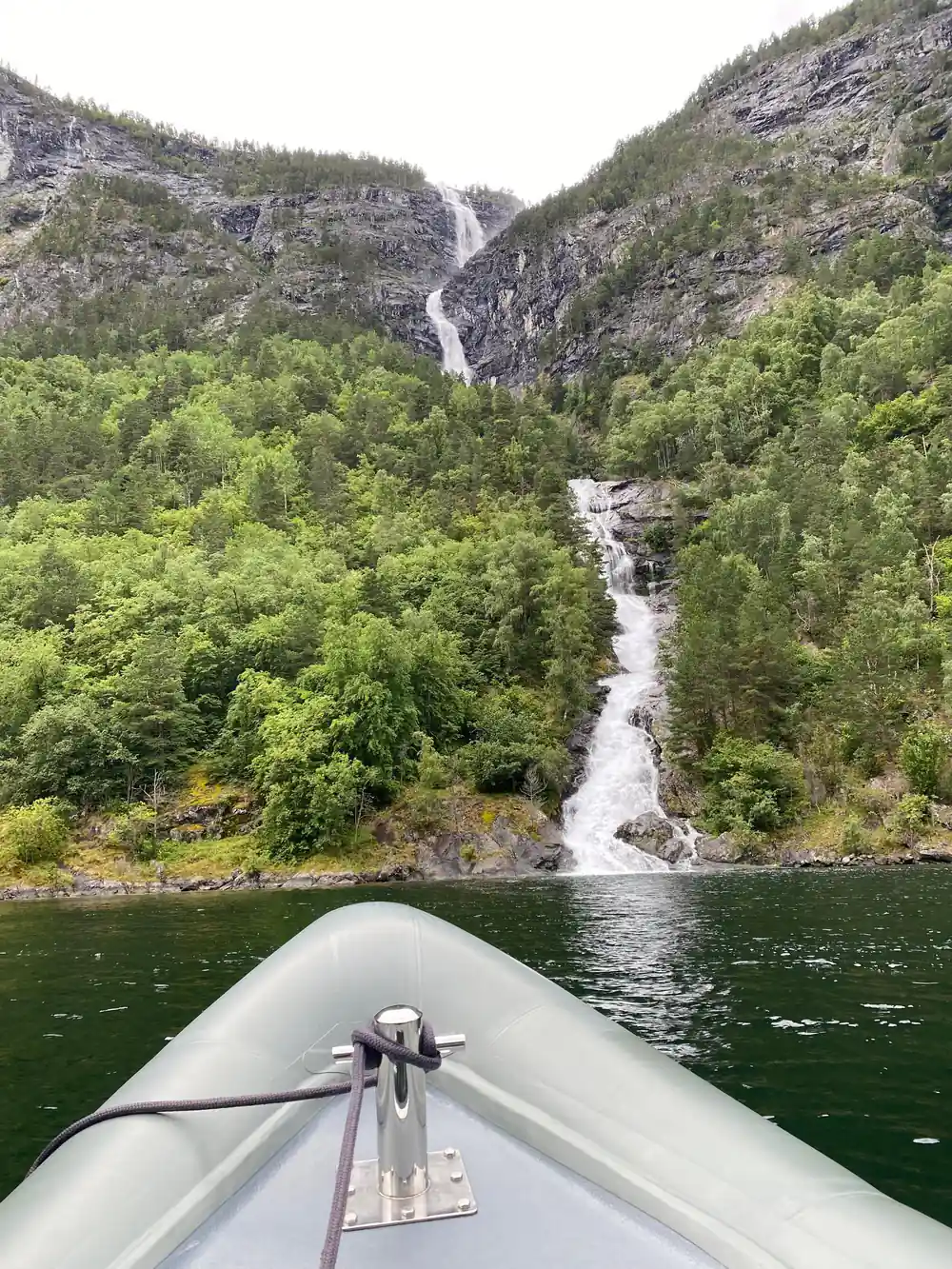
The RIB holds close to a waterfall while the fjord walls fill the sky behind it.
Speed, and what it feels like
A RIB does not push through the water so much as climb on top of it. Once the hull gets up on plane, the bow lifts, spray moves back along the tubes, and the ride becomes a series of small slaps and long glides. The wind is constant, the engine note is loud enough that normal conversation stops, and cold air comes off the water even on a warm afternoon.
The sensation is out of proportion to the speed, because everything around you is enormous. Rock walls rise close on both sides, the far end of the fjord keeps receding, and the boat feels very small. The deepest part of the Sognefjord, the great fjord that the Nærøyfjord branches off, is 1300 meters down[7].
Watch the shoreline as well as the cliffs. Both Aurlandsfjorden and Nærøyfjorden are important habitats for harbor seals, which are often seen basking on rocks or popping their heads out of the water[8]. A skipper who slows for a seal is doing the right thing; a fast boat can be on top of an animal in seconds if nobody is looking.
Shallow draft: the real advantage
Draft is the depth of water a boat needs beneath it. A RIB needs very little, because the hull is shallow and light and the engine is the only heavy thing at the back. That is what lets it leave the ferry lane and work along the shoreline, under cliffs and into corners where the water is thin. It is also what allows it to hold position close to a waterfall instead of admiring it from far off.
Kjelfossen runs down at the head of the Nærøyfjord and has a free fall of 150 metres and a total drop of 840 metres[9]. From a big cruise deck that is a stripe on a cliff. From a RIB, with spray coming across the tubes and the roar arriving in waves, it is weather.
Shallow draft also buys flexibility. A skipper can change the line of the run with the wind and the light, tuck into the lee of a headland when the fjord turns choppy, and still have everyone back at the pontoon when the trip is done.
from US$146
The Flåm RIB experience runs 2 hours with a live English-speaking guide, and is rated 4.91 from 129 reviews.[1]
How rough is it really
The Nærøyfjord is sheltered water on most days. The walls are high and the channel is narrow, so ocean swell rarely reaches far inside, and a RIB handles chop better than most boats its size. What you will notice is wind against the tide, short steep waves near the head of the fjord, and the wash of a passing ferry or cruise ship.
On a calm day the ride is fast and mostly dry, with the odd burst of spray. On a windy day you will get wet, and you will be glad of the layers you brought. Flåm's monthly average maximum temperatures run from 14°C to 30°C over the year, and average minimums from 6°C to 22°C[10].
Light changes everything. Rain on the cliffs feeds the waterfalls and makes the rock shine; low cloud hides the tops and makes the valley feel closed and private; a clear evening throws the whole north wall into gold.
Safety, noise and numbers
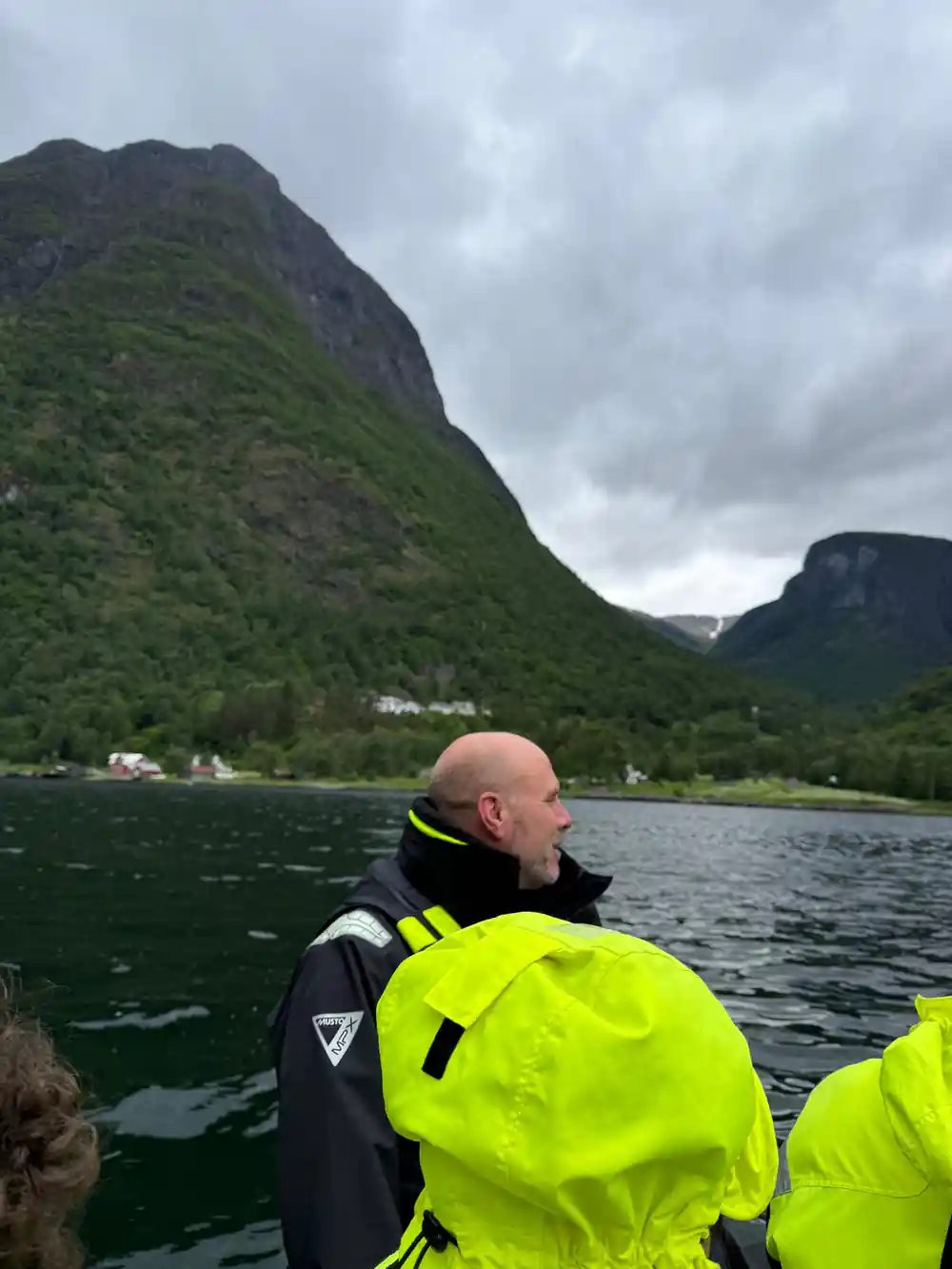
RIB trips are run by skippers who know the water and make the call on the day about where to go and how fast. Before you book, ask what protective gear is provided, what happens if the weather turns, and whether anyone in your group needs to be able to swim.
Expect noise. At speed you will not hear a normal speaking voice, so briefings happen before you leave and hand signals matter once you are moving. Sitting towards the back of the boat is usually the smoothest ride; the front rows get the airtime and the spray.
These boats are small by design, and the point of the trip is the water and the rock rather than the crowd on board. If you would rather sit indoors with a coffee and a window, a fjord cruise is the better shape of day. If you want the cliffs close and the waterfall loud, this is the format that does it.
Tide is worth thinking about as well. It changes the depth over the shallows and the look of the shoreline from hour to hour, which is part of why the same route feels different on two consecutive days.
Getting to Flåm and booking the ride
Flåm sits at the inner end of the Aurlandsfjord, the arm that leads down into the Nærøyfjord, and the harbour is the centre of the village. Gudvangen, at the far end of the fjord, has about 90 inhabitants[11]. Most people arrive by train, by coach or off a ship.
Getting there is part of the trip. The Flåm Railway climbs from 2 meters to 867 meters above sea level at a 5% gradient[12], and the cruise from Flåm to Gudvangen takes approximately two hours on the water[13]. The West Norwegian Fjords, which include the Nærøyfjord, were first recognised as a UNESCO World Heritage Site in 2005[14].
The Flåm RIB experience is listed from US$146 and takes 2 hours, with a live guide in English, free cancellation up to 24 hours in advance and the option to reserve now and pay later[1]. It is rated 4.91 from 129 reviews[1]. Starting times vary by date, so check availability for the day you want before you build the rest of your plans around it.
The scale the RIB moves through
All values in metres, as given by Fjord Tours, Kringom, visitBergen and Fjord Norway:[4][5][7][9]
From-prices for a day out on the fjord
US dollar from-prices of GetYourGuide listings:[1][2][3][15]
When to sort your RIB trip
How to plan a RIB trip
Pick your date
The RIB is an outdoor, weather-dependent outing, so leave some slack in your Flåm days and keep a backup option in mind.
Book ahead
Reserve now and pay later, with free cancellation up to 24 hours in advance[1]. That makes it easy to hold a place early.
Dress for spray
Layers, a windproof shell and footwear you do not mind getting wet. Ask what the operator provides before you travel.
Find the meeting point
Check the meeting point on your confirmation, arrive with time to spare, and keep both hands free for stepping down into the boat.
Settle in low
Take the seat or bench position you are given, keep your camera on a wrist strap, and listen for hand signals once the engine is running.
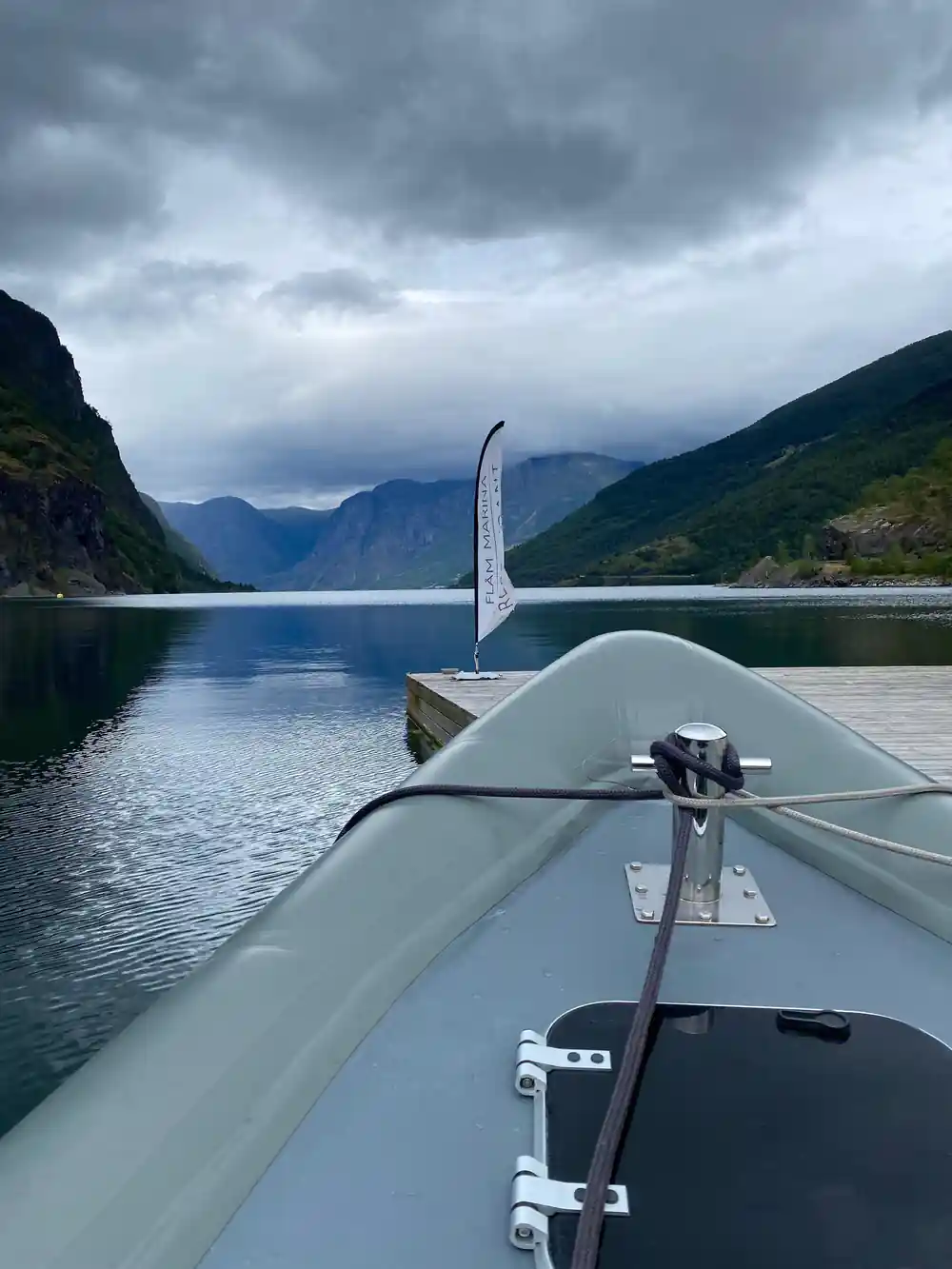
The RIB leaves from Flåm harbour and runs out to the waterfalls
from US$422Reserve now & pay later